Thursday, July 30, 2026

* All product/brand names, logos, and trademarks are property of their respective owners.
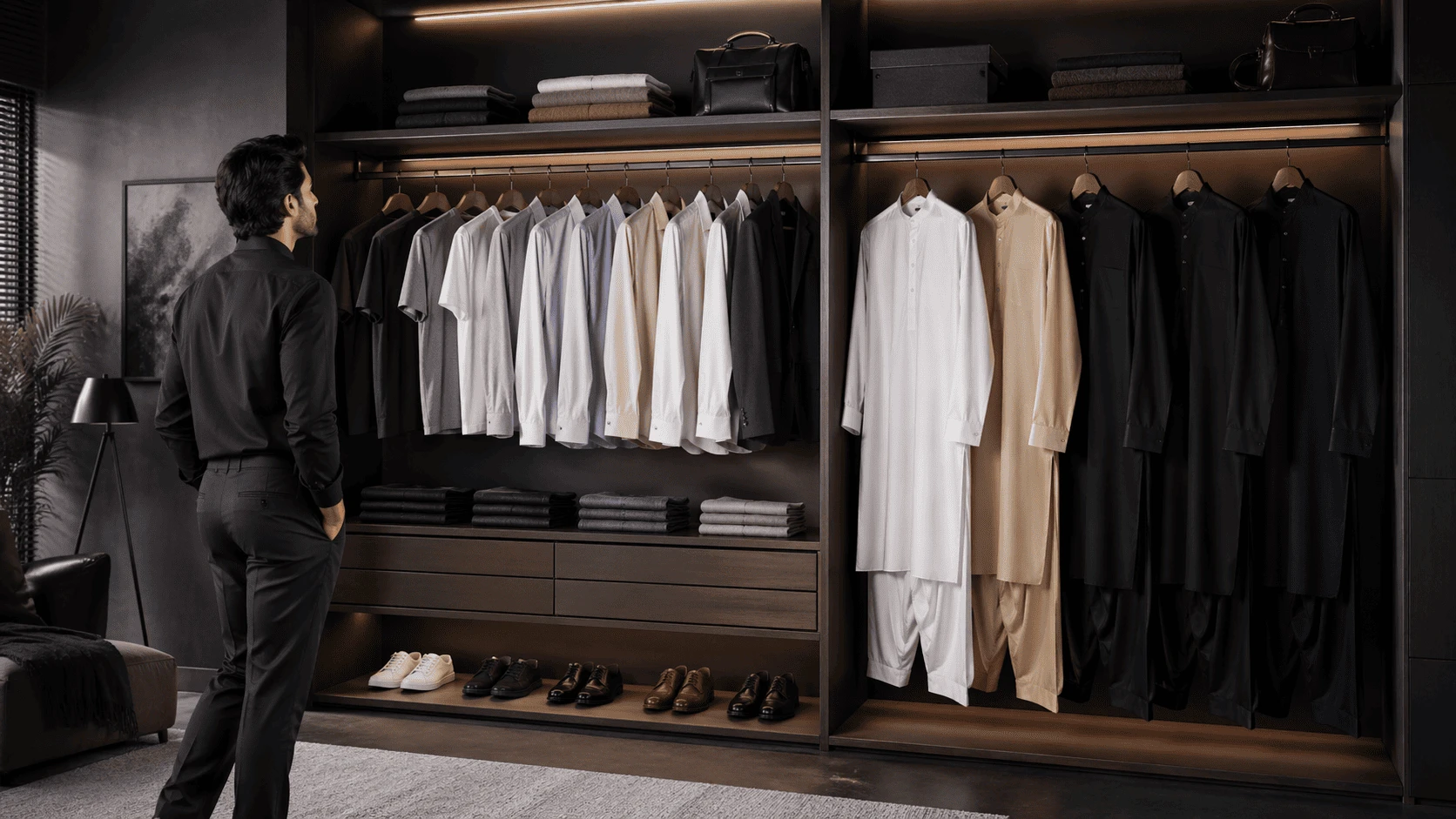
Most men keep buying clothes… yet still feel like they have nothing to wear. Your wardrobe gets bigger, but your daily outfits don’t get easier. You stand in front of a full cupboard and still default to the same 2–3 outfits. That’s not a lack of clothes — it’s a lack of clarity. This is exactly why the idea of a minimal wardrobe for men is gaining attention, especially in Pakistan where the weather is harsh, trends change fast, and unnecessary spending adds up quickly. A minimal wardrobe isn’t about owning less just for the sake of it. It’s about owning the right clothes — pieces that actually get worn, mix easily, and work across your daily life.
In this guide, you’ll learn how to stop buying clothes you don’t need and build a wardrobe that actually works — for your routine, your budget, and Pakistan’s climate.
Buying more clothes feels productive — like you’re improving your style. In reality, it usually does the opposite.
The more you buy without a plan, the harder it becomes to actually dress well.
Here’s what usually happens:
In Pakistan, this problem is even more common. Sales, Eid collections, and fast-changing trends make it easy to keep adding clothes without ever fixing your wardrobe.
The shift you need is simple:
Stop thinking “What should I buy next?”
Start thinking “What do I actually need?”
Once you make that shift, building a minimal wardrobe becomes much easier — and much smarter.
A minimal wardrobe does not mean wearing the same outfit every day or owning only a handful of clothes.
It means keeping a small collection of clothes that are easy to wear, easy to match, and useful in real life.
The focus is simple:
For men in Pakistan, that matters even more. A useful wardrobe should handle daily casual wear, office or university outfits, Friday prayers, family gatherings, and the occasional formal event — without needing a separate shopping spree for each one.
That’s why minimal does not mean boring.
A white or black t-shirt may look basic, but when it fits well and pairs with jeans, chinos, overshirts, or even a casual jacket, it becomes more useful than three trendy shirts you barely wear.
The goal is not to own less just to look disciplined.
The goal is to make every item earn its place.
A good minimal wardrobe should help you:
Once you understand that, building one becomes much easier.
Building a minimal wardrobe isn’t about throwing everything away and starting from scratch. It’s a simple process of refining what you already have and filling only the real gaps.
Follow these steps:
Start with your current wardrobe.
Take everything out and go item by item. Be honest — most people keep far more than they actually use.
Keep only what:
Remove or set aside:
A simple rule:
If you didn’t wear it in the last season, you probably don’t need it.
Your wardrobe becomes easier when your colors work together.
Stick to neutral, easy-to-match tones:
These colors allow you to create multiple outfits without thinking too much.
For example:
You can still add 1–2 accent colors, but keep the base simple.
Every item you keep or buy should serve more than one purpose.
Good examples:
Avoid items that only work in one situation.
If something can only be worn once in a while, it doesn’t deserve space in a minimal wardrobe.
This is where most people fail — they never define “how much is enough.”
Set a clear limit so you don’t overbuy again.
Instead of saying:
“I need more shirts.”
Say:
“I only need 4–5 shirts total.”
This forces you to choose better instead of buying more.
In the next section, we’ll break down a practical minimal wardrobe checklist for Pakistani men, including how many items you actually need.
Now that you’ve cleared your wardrobe and set a direction, here’s a practical breakdown of what you actually need.
This is not about strict rules — it’s about giving you a clear limit so you don’t fall back into overbuying.
| Category | Items | Quantity |
|---|---|---|
| T-Shirts | Plain, solid colors | 4–6 |
| Shirts | Casual + semi-formal | 3–5 |
| Pants | Jeans + chinos | 2–3 |
| Shalwar Kameez | Neutral, everyday wear | 2–3 |
| Shoes | Sneakers + formal | 2–3 |
| Outerwear | Light jacket/layer (optional) | 1–2 |
One of the biggest advantages Pakistani men have is flexibility — you’re not limited to just Western outfits or just traditional wear.
A smart minimal wardrobe uses both, without overloading your closet.
The key is balance.
Don’t overcomplicate either side.
Avoid heavy designs, loud prints, or overly trendy pieces. The simpler your clothes, the easier they are to mix.
You don’t need dozens of outfits. A few smart combinations are enough:
A minimal wardrobe isn’t just about fewer clothes — it’s also about spending smarter.
You don’t need expensive brands or big shopping trips. You just need to avoid waste and focus on value.
Instead of buying 5 cheap items, buy 1–2 that you’ll actually wear often.
Look for:
A slightly better-quality item will last longer and look better over time.
Weather matters more than trends.
For most cities like Multan, Lahore, and Karachi:
Avoid heavy or uncomfortable fabrics that you’ll end up not wearing.
Before buying anything, ask:
If the answer isn’t clear, skip it.
Sales are useful only if you’re already planning to buy something.
Smart approach:
Avoid random purchases just because prices are lower.
Building a better wardrobe doesn’t start with buying more clothes — it starts with buying less and choosing better.
A minimal wardrobe for men is really about clarity. When you own fewer, well-chosen pieces, everything becomes easier:
You don’t need a massive collection to look good. You need a small set of clothes that actually work for your daily life in Pakistan — from casual wear to Jummah and social events.
Start simple:
From there, your wardrobe naturally becomes more functional, more affordable, and easier to manage.
The goal isn’t perfection. It’s control.

I am Zeenat, an SEO Specialist and Content Writer specializing in on-page and off-page SEO to improve website visibility, user experience, and performance.
I optimize website content, meta elements, and site structure, and implement effective off-page SEO strategies, including link building and authority development. Through keyword research and performance analysis, I drive targeted organic traffic and improve search rankings.
I create high-quality, search-optimized content using data-driven, white-hat SEO practices, focused on delivering sustainable, long-term growth and improved online visibility.
Summer in Pakistan isn’t just warm — it’s intense. When temperatures cross 40°
22 April 2026
For years, people have argued about streetwear vs classic style like one of them has to win for
9 April 2026
Be the first to share your thoughts
No comments yet. Be the first to comment!
Share your thoughts and join the discussion below.